Introducing AWS Capabilities by Region for easier Regional planning and faster global deployments

This post was originally published on this site

At AWS, a common question we hear is: “Which AWS capabilities are available in different Regions?” It’s a critical question whether you’re planning Regional expansion, ensuring compliance with data residency requirements, or architecting for disaster recovery.

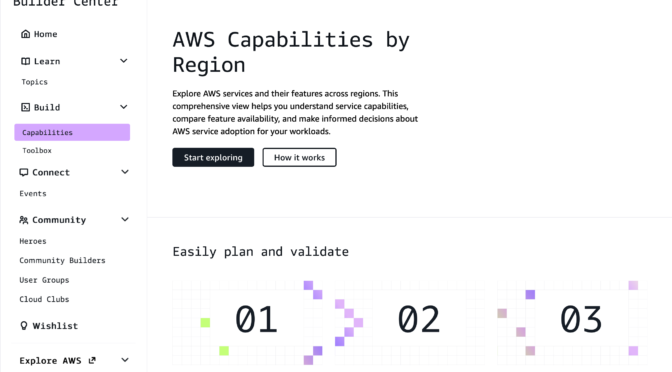
Today, I’m excited to introduce AWS Capabilities by Region, a new planning tool that helps you discover and compare AWS services, features, APIs, and AWS CloudFormation resources across Regions. You can explore service availability through an interactive interface, compare multiple Regions side-by-side, and view forward-looking roadmap information. This detailed visibility helps you make informed decisions about global deployments and avoid project delays and costly rework.
Getting started with Regional comparison
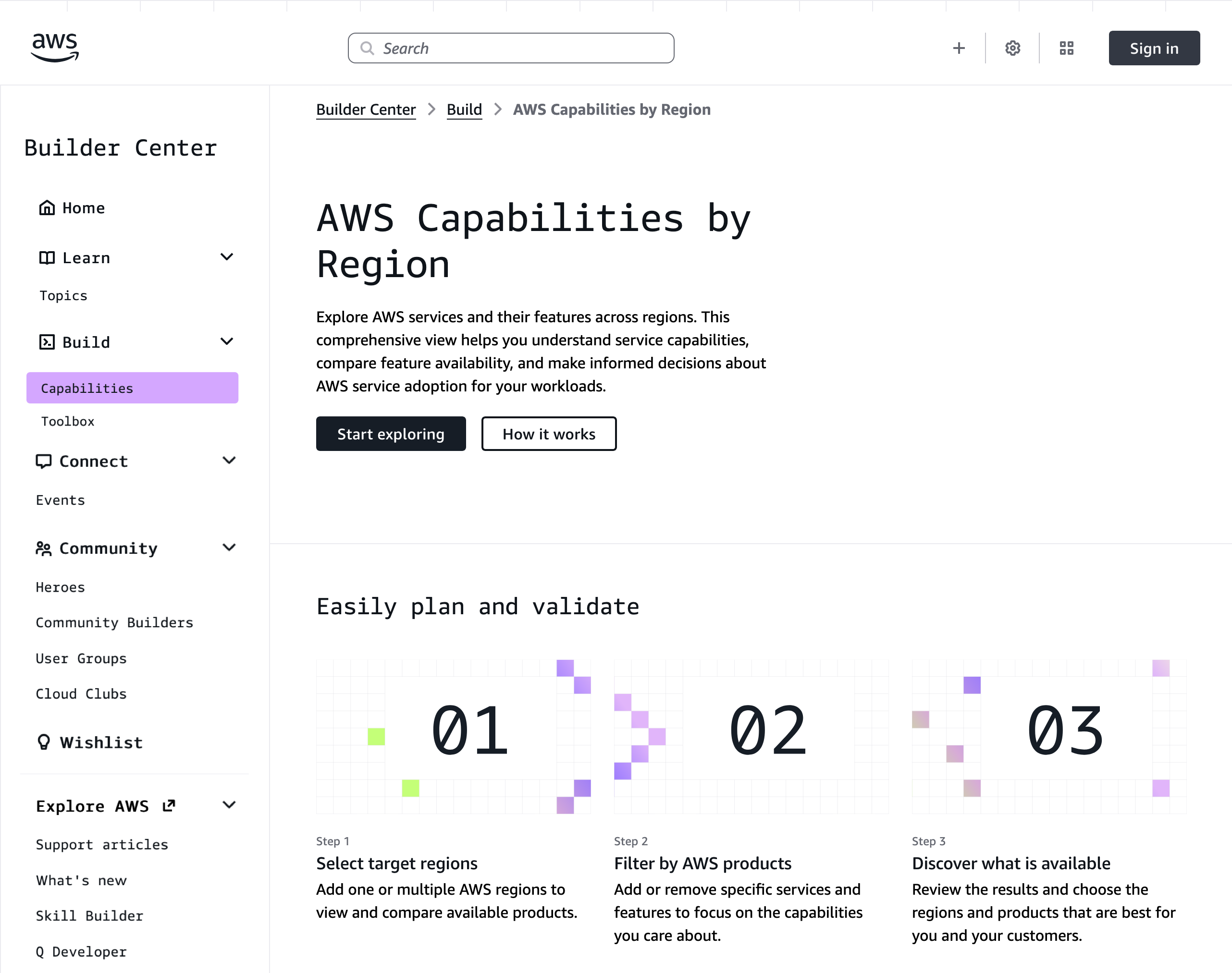
To get started, go to AWS Builder Center and choose AWS Capabilities and Start Exploring. When you select Services and features, you can choose the AWS Regions you’re most interested in from the dropdown list. You can use the search box to quickly find specific services or features. For example, I chose US (N. Virginia), Asia Pacific (Seoul), and Asia Pacific (Taipei) Regions to compare Amazon Simple Storage Service (Amazon S3) features.

Now I can view the availability of services and features in my chosen Regions and also see when they’re expected to be released. Select Show only common features to identify capabilities consistently available across all selected Regions, ensuring you design with services you can use everywhere.
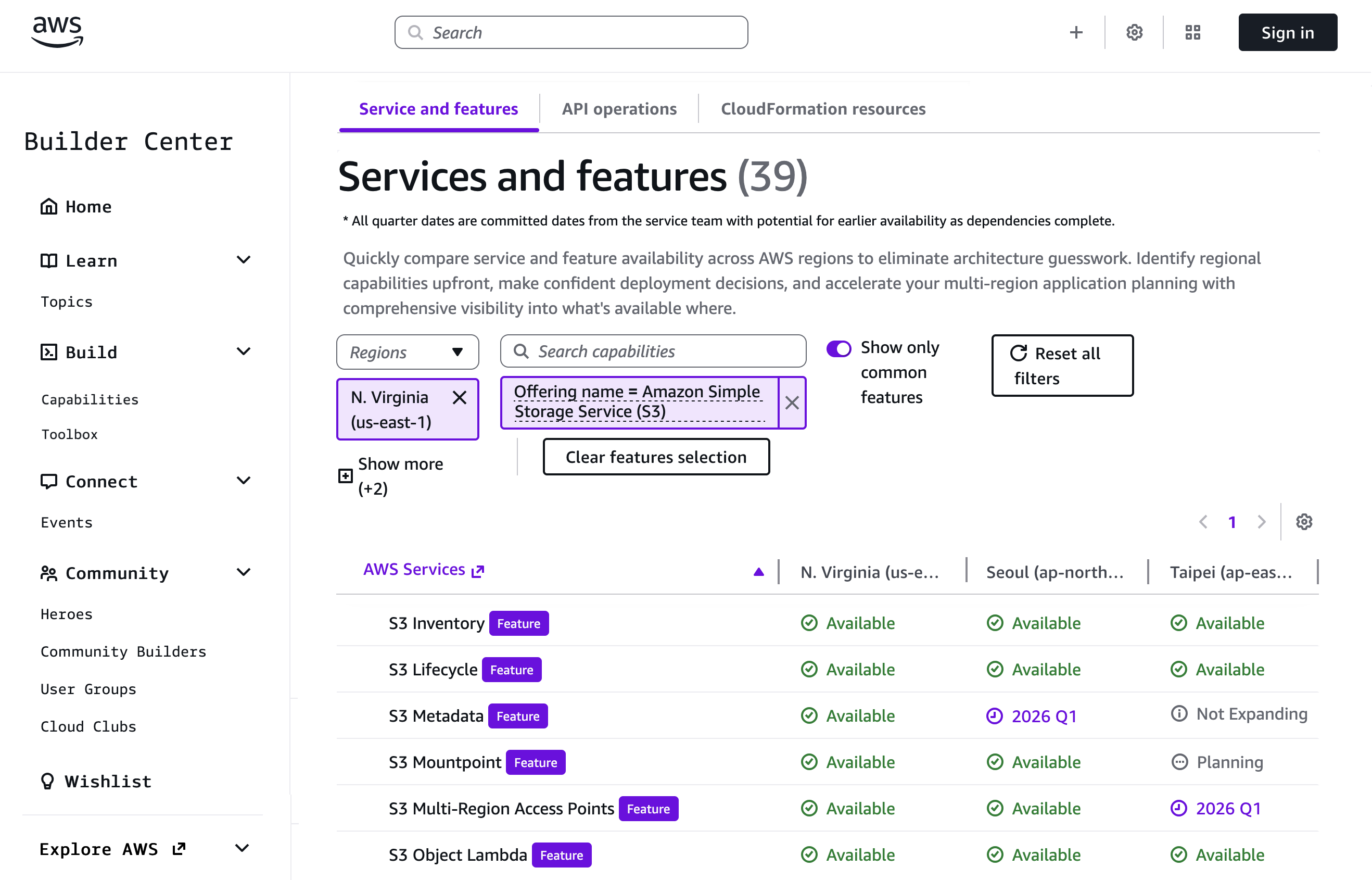
The result will indicate availability using the following states: Available (live in the region); Planning (evaluating launch strategy); Not Expanding (will not launch in region); and 2026 Q1 (directional launch planning for the specified quarter).

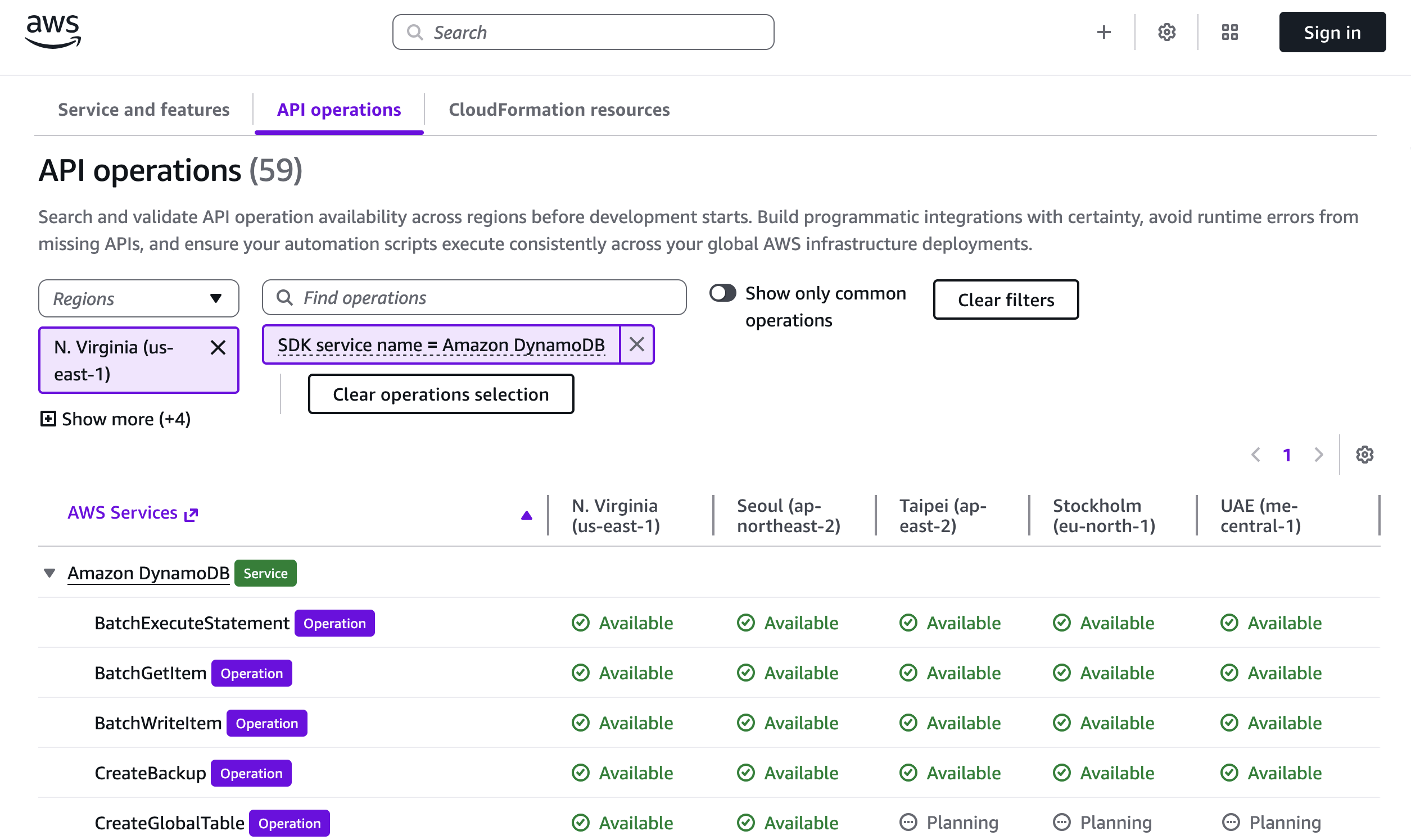
In addition to exploring services and features, AWS Capabilities by Region also helps you explore available APIs and CloudFormation resources. As an example, to explore API operations, I added Europe (Stockholm) and Middle East (UAE) Regions to compare Amazon DynamoDB features across different geographies. The tool lets you view and search the availability of API operations in each Region.
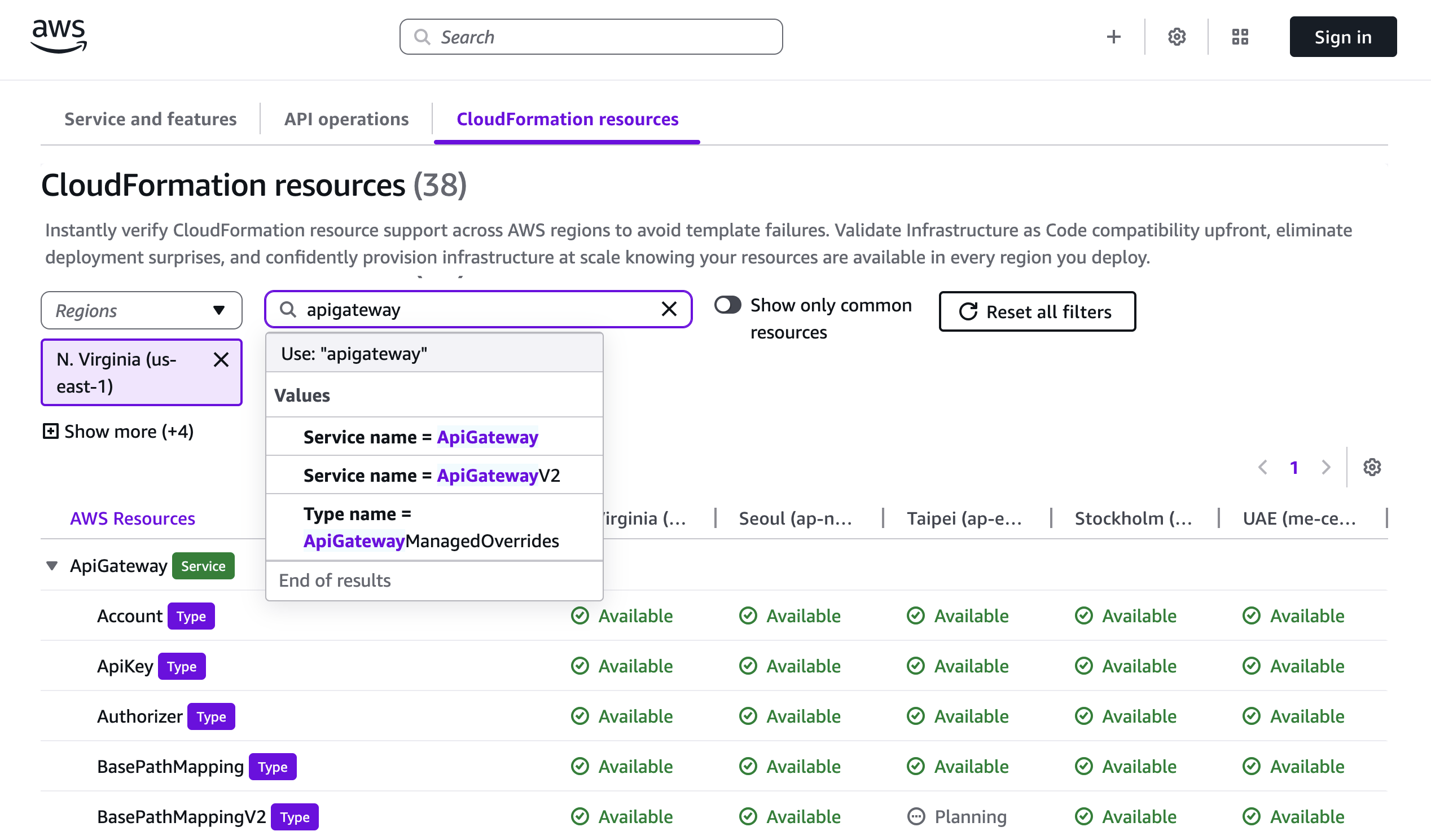
The CloudFormation resources tab helps you verify Regional support for specific resource types before writing your templates. You can search by Service, Type, Property, and Config.For instance, when planning an Amazon API Gateway deployment, you can check the availability of resource types like AWS::ApiGateway::Account.
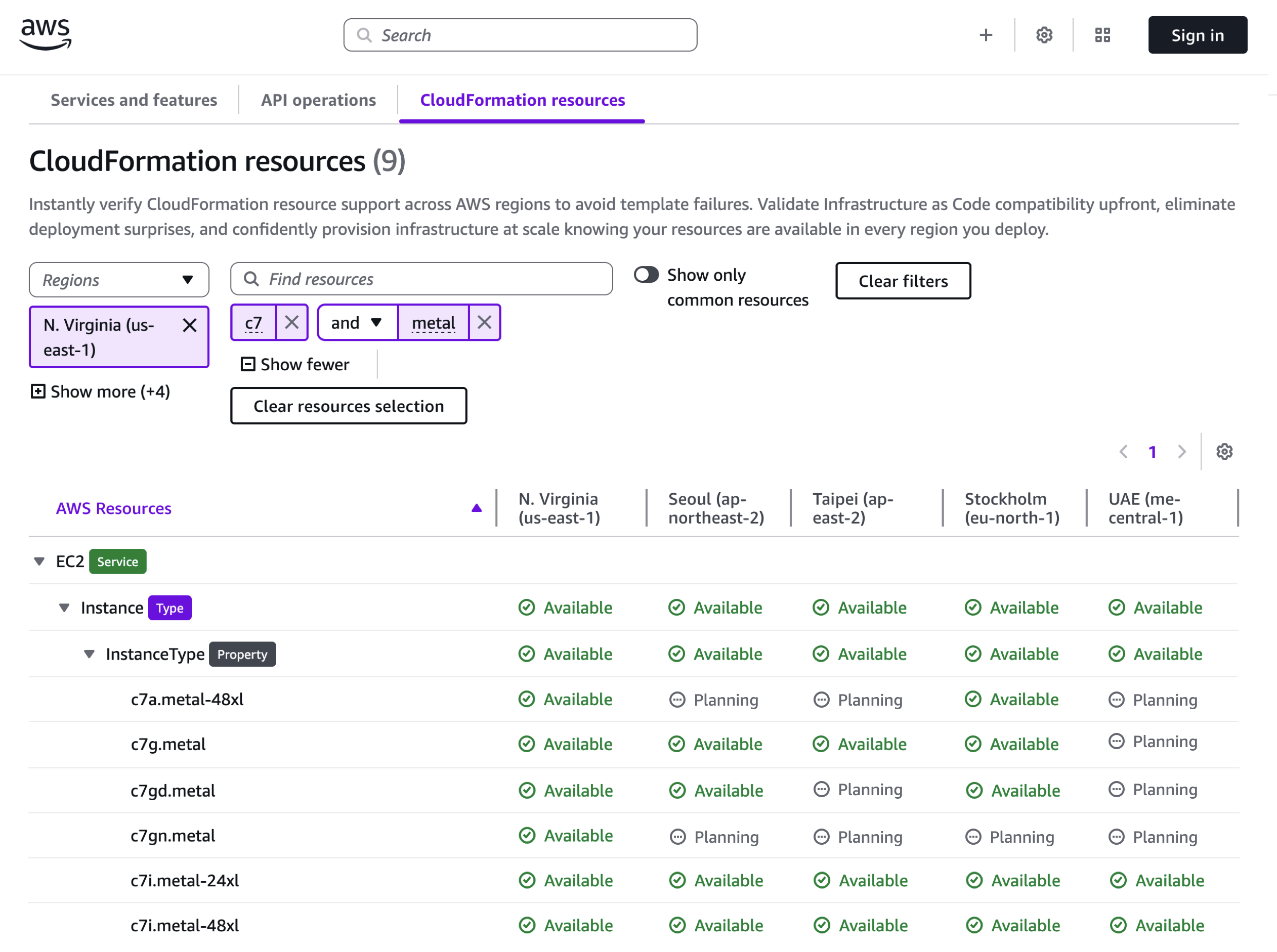
You can also search detailed resources such as Amazon Elastic Compute Cloud (Amazon EC2) instance type availability, including specialized instances such as Graviton-based, GPU-enabled, and memory-optimized variants. For example, I searched 7th generation compute-optimized metal instances and could find c7i.metal-24xl and c7i.metal-48xl instances are available across all targeted Regions.
Beyond the interactive interface, the AWS Capabilities by Region data is also accessible through the AWS Knowledge MCP Server. This allows you to automate Region expansion planning, generate AI-powered recommendations for Region and service selection, and integrate Regional capability checks directly into your development workflows and CI/CD pipelines.
Now available
You can begin exploring AWS Capabilities by Region in AWS Builder Center immediately. The Knowledge MCP server is also publicly accessible at no cost and does not require an AWS account. Usage is subject to rate limits. Follow the getting started guide for setup instructions.

We would love to hear your feedback, so please send us any suggestions through the Builder Support page.

Channy

AWS Weekly Roundup: Project Rainier online, Amazon Nova, Amazon Bedrock, and more (November 3, 2025)

This post was originally published on this site

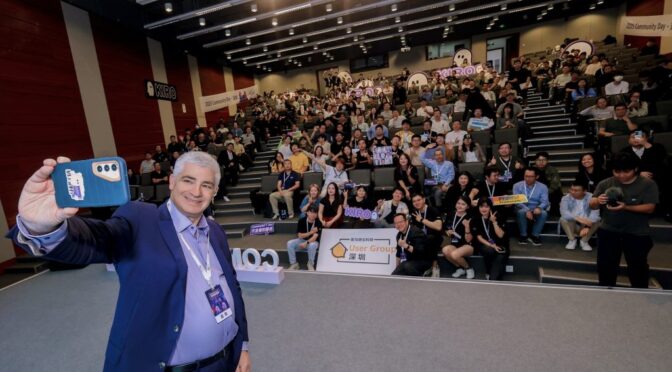
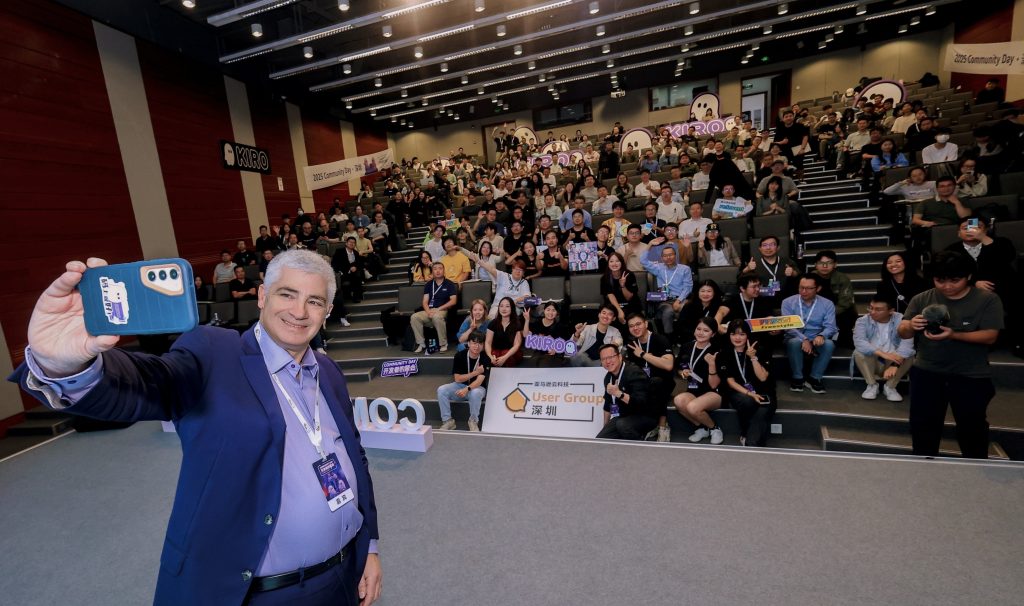
Last week I met Jeff Barr at the AWS Shenzhen Community Day. Jeff shared stories about how builders around the world are experimenting with generative AI and encouraged local developers to keep pushing ideas into real prototypes. Many attendees stayed after the sessions to discuss model grounding, evaluation, and how to bring generative AI into real applications.

Community builders showcased creative Kiro-themed demos, AI-powered IoT projects, and student-led experiments. It was inspiring to see new developers, students, and long-time Amazon Web Services (AWS) community leaders connecting over shared curiosity and excitement for generative AI innovation.

Project Rainier, one of the world’s most powerful operational AI supercomputers is now online. Built by AWS in close collaboration with Anthropic, Project Rainier brings nearly 500,000 AWS custom-designed Trainium2 chips into service using a new Amazon Elastic Compute (Amazon EC2) UltraServer and EC2 UltraCluster architecture designed for high-bandwidth, low-latency model training at hyperscale.

Anthropic is already training and running inference for Claude on Project Rainier, and is expected to scale to more than one million Trainium2 chips across direct usage and Amazon Bedrock by the end of 2025. For architecture details, deployment insights, and behind-the-scenes video of an UltraServer coming online, refer to AWS activates Project Rainier for the full announcement.

Last week’s launches
Here are the launches that got my attention this week:

Additional updates
Here are some additional projects, blog posts, and news items that I found interesting:

  • Building production-ready 3D pipelines with AWS VAMS and 4D Pipeline – A reference architecture for creating scalable, cloud-based 3D asset pipelines using AWS Visual Asset Management System (VAMS) and 4D Pipeline, supporting ingest, validation, collaborative review, and distribution across games, visual effects (VFX), and digital twins.
  • Amazon Location Service introduces new API key restrictions – You can now create granular security policies with bundle IDs to restrict API access to specific mobile applications, improving access control and strengthening application-level security across location-based workloads.
  • AWS Clean Rooms launches advanced SQL configurations – A performance enhancement for Spark SQL workloads that supports runtime customization of Spark properties and compute sizes, plus table caching for faster and more cost-efficient processing of large analytical queries.
  • AWS Serverless MCP Server adds event source mappings (ESM) tools – A capability for event-driven serverless applications that supports configuration, performance tuning, and troubleshooting of AWS Lambda event source mappings, including AWS Serverless Application Model (AWS SAM) template generation and diagnostic insights.
  • AWS IoT Greengrass releases an AI agent context pack – A development accelerator for cloud-connected edge applications that provides ready-to-use instructions, examples, and templates, helping teams integrate generative AI tools such as Amazon Q for faster software creation, testing, and fleet-wide deployment. It’s available as open source on the GitHub repository.
  • AWS Step Functions introduces a new metrics dashboard – You can now view usage, billing, and performance metrics at the state-machine level for standard and express workflows in a single console view, improving visibility and troubleshooting for distributed applications.

Upcoming AWS events
Check your calendars so that you can sign up for these upcoming events:

  • AWS Builder Loft – A community tech space in San Francisco where you can learn from expert sessions, join hands-on workshops, explore AI and emerging technologies, and collaborate with other builders to accelerate their ideas. Browse the upcoming sessions and join the events that interest you.
  • AWS Community Days – Join community-led conferences that feature technical discussions, workshops, and hands-on labs led by experienced AWS users and industry leaders from around the world: Hong Kong (November 2), Abuja (November 8), Cameroon (November 8), and Spain (November 15).
  • AWS Skills Center Seattle 4th Anniversary Celebration – A free, public event on November 20 with a keynote, learned panels, recruiter insights, raffles, and virtual participation options.

Join the AWS Builder Center to learn, build, and connect with builders in the AWS community. Browse here for upcoming in-person events, developer-focused events, and events for startups.

That’s all for this week. Check back next Monday for another Weekly Roundup!

Betty

XWiki SolrSearch Exploit Attempts (CVE-2025-24893) with link to Chicago Gangs/Rappers, (Mon, Nov 3rd)

This post was originally published on this site

XWiki describes itself as "The Advanced Open-Source Enterprise Wiki" and considers itself an alternative to Confluence and MediaWiki. In February, XWiki released an advisory (and patch) for an arbitrary remote code execution vulnerability. Affected was the SolrSearch component, which any user, even with minimal "Guest" privileges, can use. The advisory included PoC code, so it is a bit odd that it took so long for the vulnerability to be widely exploited.

Scans for Port 8530/8531 (TCP). Likely related to WSUS Vulnerability CVE-2025-59287, (Sun, Nov 2nd)

This post was originally published on this site

Sensors reporting firewall logs detected a significant increase in scans for port 8530/TCP and 8531/TCP over the course of last week. Some of these reports originate from Shadowserver, and likely other researchers, but there are also some that do not correspond to known research-related IP addresses.